
Hikari Ultra LED Review
A discontinued LED kit remembered for exceptional version-1.0 reflector and projector results, a tightly focused emitter layout, cool-white color, and strong under-$100 value in its original test period.
- Reflector low beam
- 4,390 luxper bulb · historical v1.0 test
- Projector low beam
- 3,030 luxper bulb · historical v1.0 test
- Measured output
- 2,735 lmper bulb · 5,470 lm per kit
- Color temperature
- 6,450 Kmeasured
Our verdict
The Hikari Ultra was one of the strongest Amazon-sold LED kits in the original BulbFacts test era. Its concentrated emitter layout produced large reflector and projector gains, the reflector pattern earned a separate 5 / 5 rating, and measured power and heat stayed modest. Those results remain useful historical evidence, but the product is discontinued, its version-1.0 lux readings are not directly comparable to the current chart, and installation still depends on housing fit, aim, electronics, and clearance.
What we liked
- Large historical low-beam gains in both reflector and projector reference housings.
- A separate 5 / 5 reflector beam-pattern rating and a low 50-lux glare reading in the original test format.
- Low 23.1-watt-per-bulb draw, cool recorded running temperature, and a refined multi-emitter layout for its era.
What to consider
- The version-1.0 lux values cannot be treated as current-chart rankings, and no numerical performance scores were preserved.
- The fixed collar, external driver, 71 dB bench result, and lack of recorded DRL dimming require fitment and electronics checks.
- No matching high-beam photographs, current product listing, completed lifespan result, or exact-vehicle compatibility record is available.
Build quality
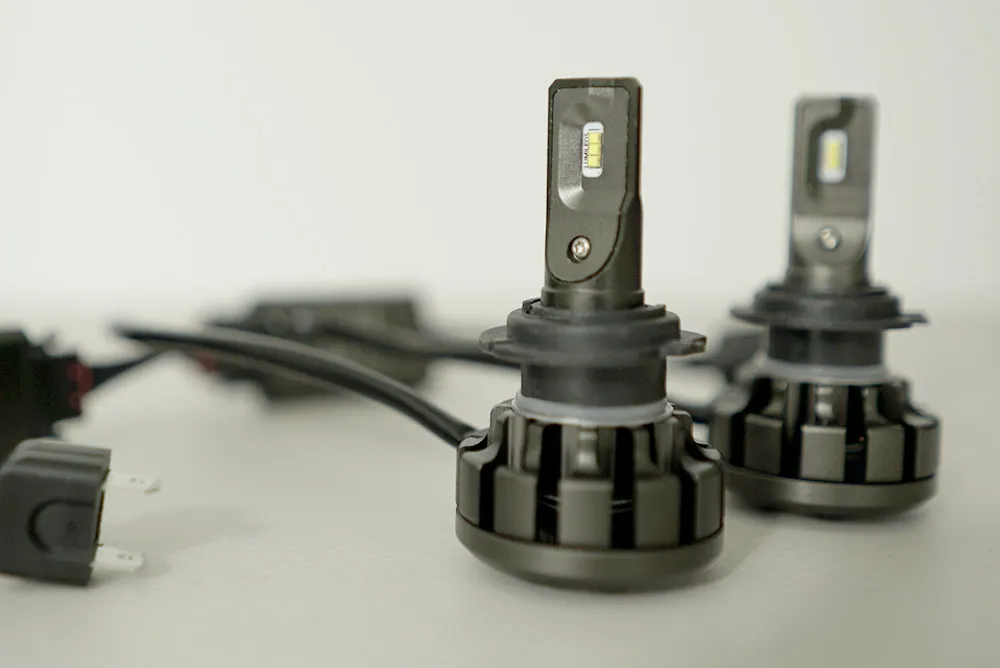
When this review was published, many marketplace LED kits still used older single-chip designs that performed poorly. The Hikari Ultra cost more than those generic kits, but its construction and measured results made that premium easier to justify.
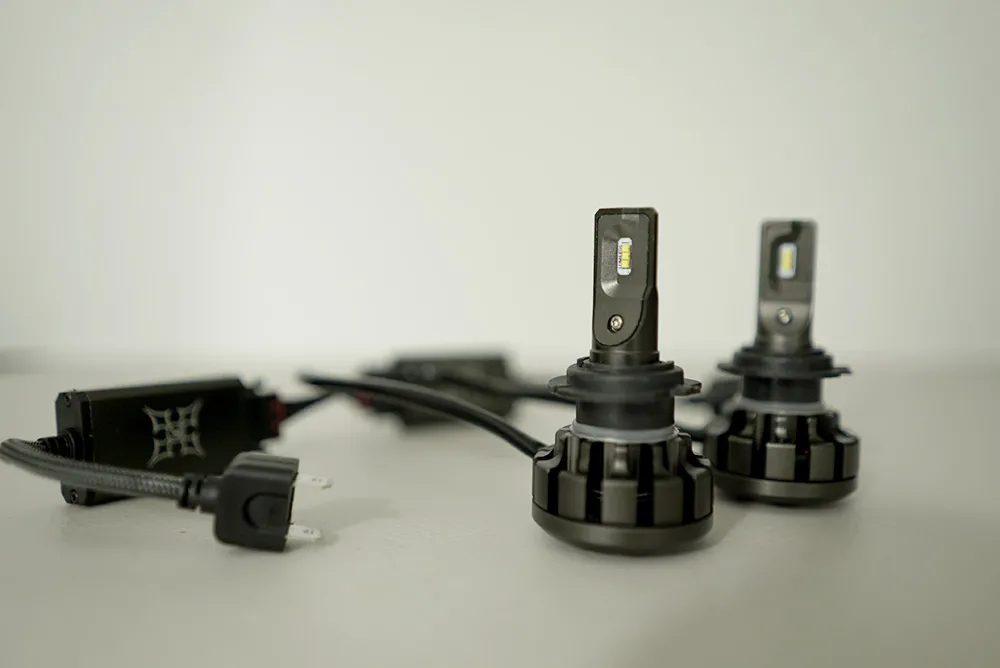
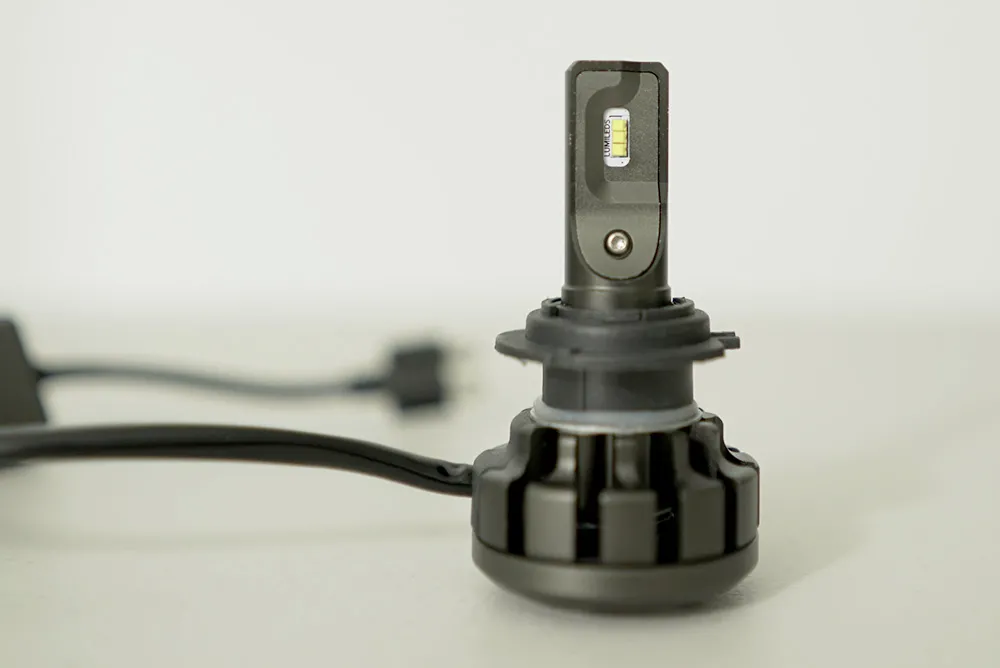
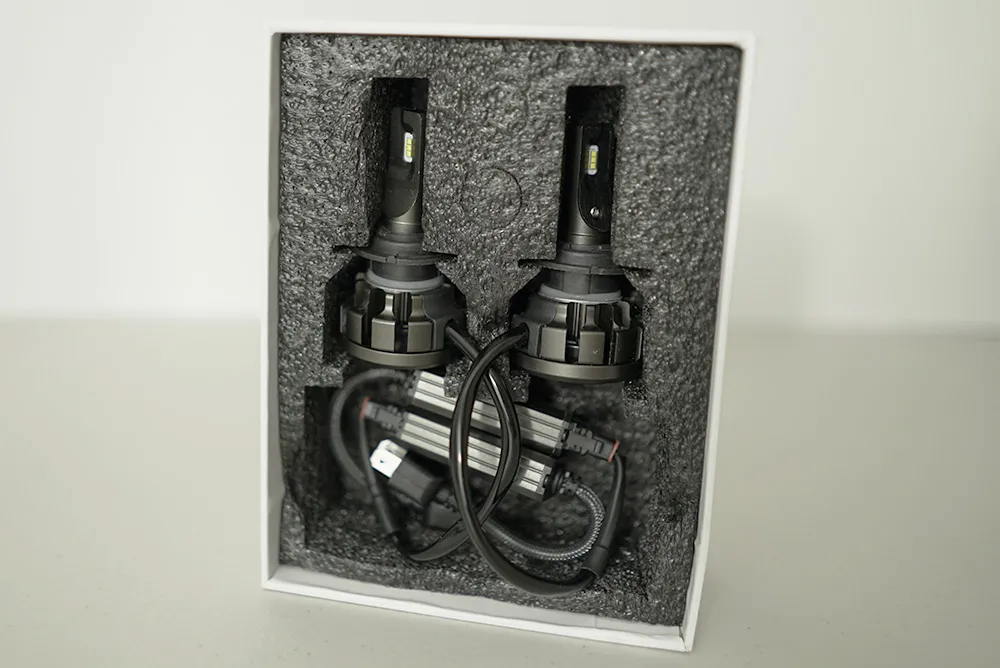
Each bulb uses six Philips Lumileds Luxeon Z ES emitters—three per side—on a flat board. The emitter areas are offset rather than perfectly symmetrical, a distinctive layout that appeared to focus light unusually well in the reflector housings we tested.
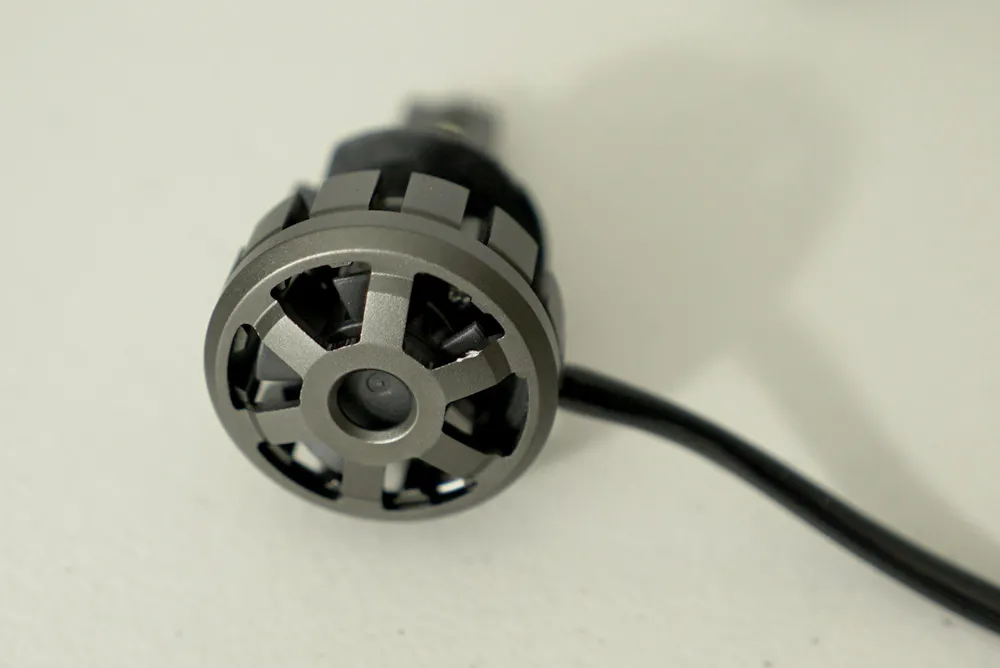
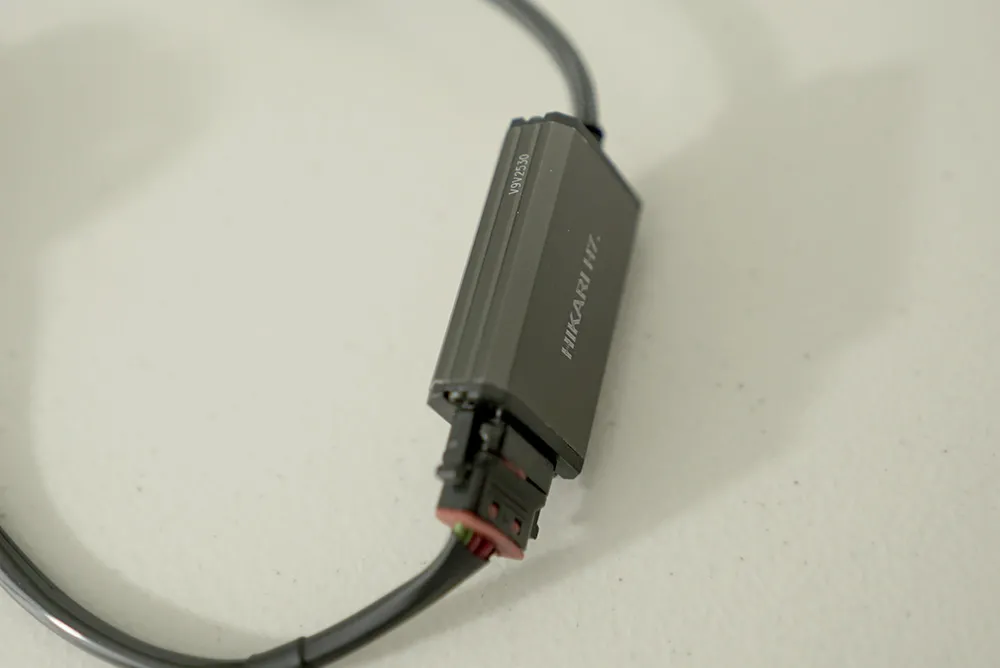
The bulb body, active fan, braided wiring, and removable external driver form a more substantial package than a simple halogen bulb. Hikari advertised 12,000 lumens per kit, while the archived facts table records 5,470 measured lumens per kit; the bench result, not the marketing claim, is used throughout this review.
Reflector headlight performance
The Hikari Ultra produced the standout low-beam result from its original test set while keeping glare controlled and earning the highest separate pattern rating.
Historical-test context: These measurements come from the version-1.0 BulbFacts bench and archived 12-foot photograph. They should not be positioned against today’s differently recorded chart range, and they do not predict an exact vehicle.
The archived article described this as its leading reflector result and separately recorded a 5 / 5 beam-pattern rating, but it did not preserve a numerical performance score. None has been inferred.
- Low-beam hotspot
- 4,390 luxper bulb · historical v1.0 test
- High-beam output
- 6,670 luxper bulb · historical v1.0 test
- Glare measurement
- 50 luxat 4 in · historical test
- Beam pattern
- 5 / 5separate pattern rating
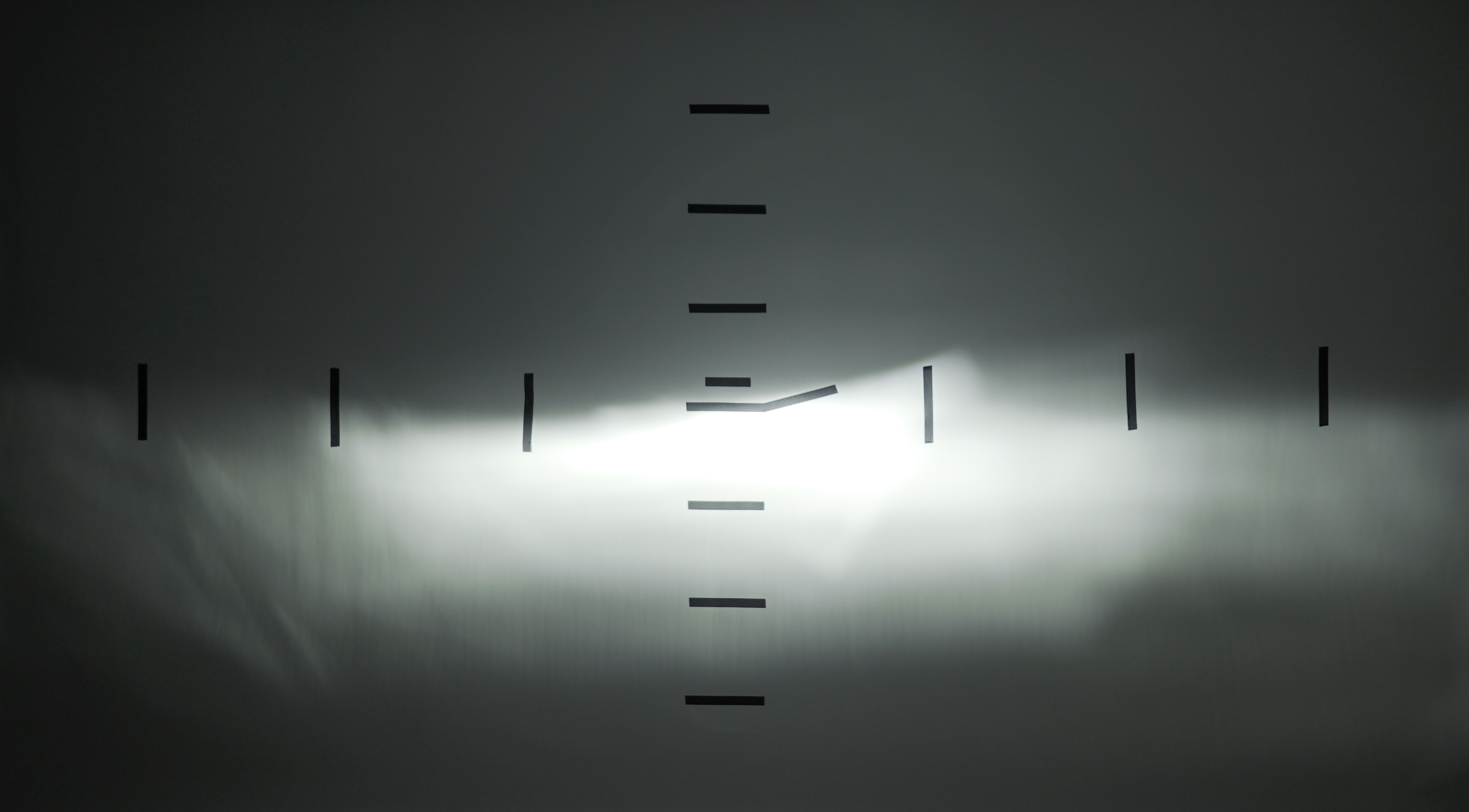
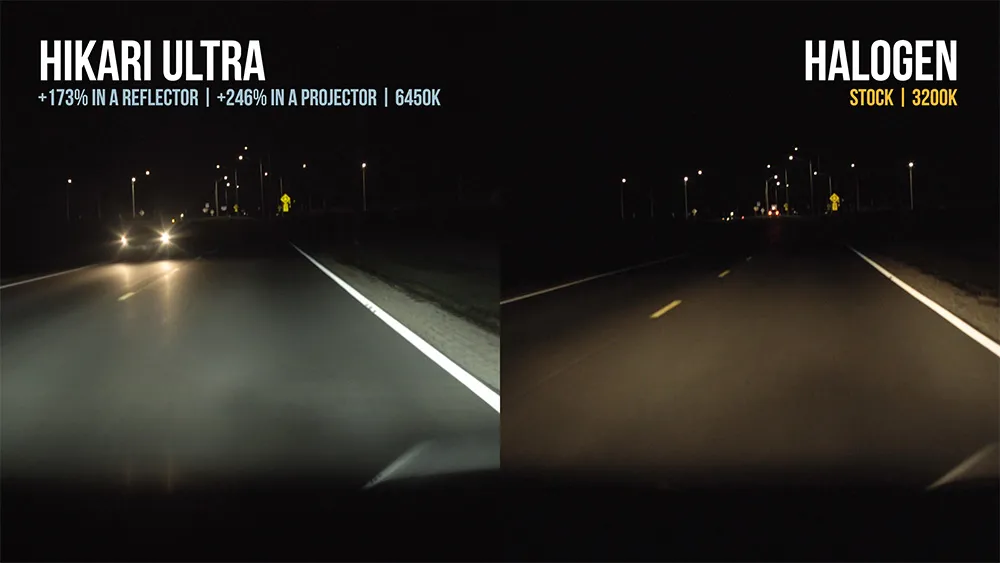
Reflector low beam measured 4,390 lux per bulb at 12 feet, or 8,780 lux for the pair, compared with 3,220 lux for the halogen pair in the same historical test. The article described that as 173% more light, or roughly 2.7 times the recorded halogen result.
The separate 5 / 5 beam-pattern rating describes beam shape rather than an overall performance score. The archived record also lists 50 lux of glare at 4 inches and reports near-perfect or perfect patterns in several reflector headlights.
High beam measured 6,670 lux per bulb, about 88% more light than the recorded halogen result. Housing optics, aim, lens condition, and seating can change output and glare in an individual vehicle.
Projector headlight performance
The projector test also recorded a large low-beam gain, although the original notes documented small dark areas and did not preserve a numerical projector pattern or glare rating.
The archived article described this as its leading projector result but did not preserve a numerical performance score, projector pattern rating, or projector glare measurement. None has been inferred.
- Low-beam hotspot
- 3,030 luxper bulb · historical v1.0 test
- High-beam output
- 6,140 luxper bulb · historical v1.0 test
- Beam pattern
- Not ratedno numerical projector record
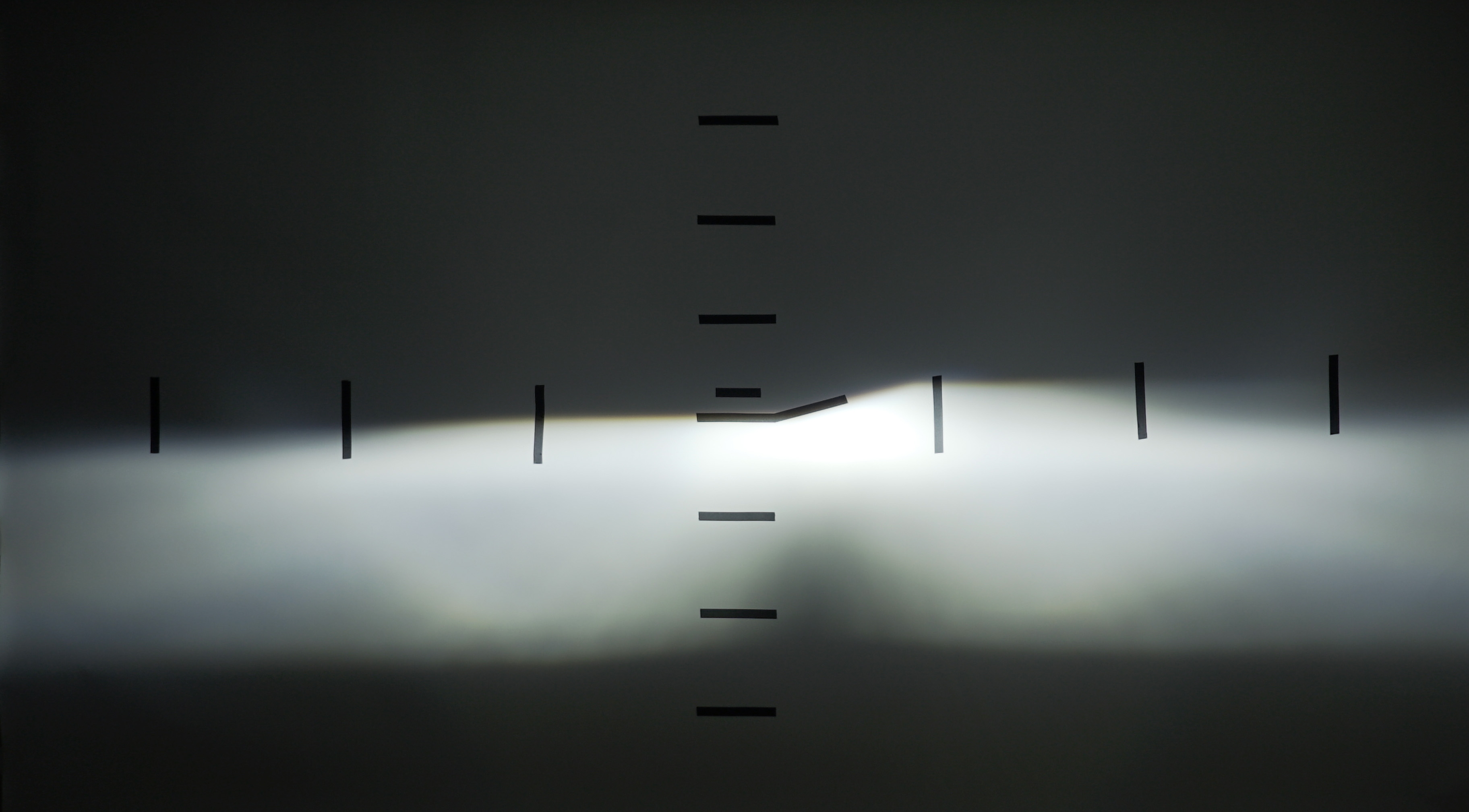
Projector low beam measured 3,030 lux per bulb. The archived article described that as 246% more light than the recorded halogen result.
High beam measured 6,140 lux per bulb, about 105% more light than halogen in the same test era. The article also noted that some higher-end HID systems could still produce more light.
The beam was described as very good but not perfect. A small dark area appeared in the lower center and another immediately in front of the car; the reviewer did not consider either severe during driving. No numerical projector pattern or glare result was preserved, and the reference housing does not guarantee the same behavior in a selected vehicle.
Output, color, and stability
The Hikari Ultra paired strong integrating-sphere output with the cool-white, slightly blue appearance common to many LEDs from its test era.
Hikari Ultra Kelvin
Hikari Ultra lumens
Color temperature measured 6,450K. The archived review described it as mostly white with some light blue—close to a modern xenon look but slightly bluer. For context, that article placed stock halogen around 3,400K and upgraded halogen around 3,700K.
The archived facts table records 5,470 lumens per kit, or 2,735 lumens per bulb. The narrative paragraph says 5,570 total lumens, creating a 100-lumen source discrepancy; the standardized display uses the dedicated facts-table value and preserves the mismatch here rather than silently changing it.
The manufacturer’s 12,000-lumen claim was far above either measured figure. No cold-start-to-30-minute or two-minute-to-30-minute stability percentage was preserved, so this review does not invent one.
Installation and cooling
The fixed collar, 32 mm recorded heat-sink size, external driver, active fan, and lack of DRL dimming are the practical details to check before using remaining stock or maintaining an existing installation.
Per-bulb draw
Recorded temp
Fan noise
Physical size and fit
The archived facts record a 32 mm heat-sink size, but the dimension’s exact width/length basis and the complete base-to-rear measurement were not preserved. The bulb is not rotatable, so correct emitter orientation depends on the bulb and housing geometry rather than collar adjustment.
The original conclusion said the kit was offered in almost every common bulb size, but a complete size list was not preserved. An available base alone does not prove fitment: verify bulb type, seating, orientation, rear clearance, driver placement, dust-cover space, and vehicle electronics.
Power draw and cooling
Power draw measured 23.1 watts per bulb. The 46.2-watt pair total is derived from that per-bulb measurement rather than independently measured as a complete kit.
Running temperature was recorded at approximately 100°F / 38°C. The archive does not preserve the exact timing basis, so it is presented as a running-temperature result rather than relabeled as a 30-minute measurement. The active fan manages heat, but this is not a completed durability result.
Noise, electronics, and DRL behavior
Fan noise measured 71 dB on the bench. No in-cabin sound measurement was recorded, so the result describes the test environment rather than how loud a specific installation will sound.
The archived facts say the kit did not support the recorded DRL / high-beam dimming test. CANBUS behavior and radio-frequency interference were not recorded, so neither compatibility nor interference performance should be assumed for an individual vehicle.
Warranty and long-term testing
Coverage
The product was listed with a two-year warranty. That was manufacturer or seller coverage, not evidence of measured service life, and current coverage should not be assumed for a discontinued product.
Long-term lifespan testing remains N/A. The cool running-temperature result and positive original recommendation do not replace a completed runtime test.
Should you buy it?
The Hikari Ultra remains an important historical benchmark. Its large version-1.0 gains, separate 5 / 5 reflector pattern rating, low recorded glare, measured output, and cool running temperature explain why the original article called it one of the best LED kits under $100.
Its limitations now carry more weight: the product is discontinued, the fixed bulb and external driver need room, the fan was loud on the bench, DRL dimming was not supported, and no completed lifespan or exact-vehicle compatibility result was recorded.
Current buyers should use the newer Hikari review and current chart rather than treating these historical lux values as a present-day ranking. Owners of remaining stock should confirm fitment, electronics, and aim in the actual vehicle.
Compare current Hikari products and current recommendations before choosing a replacement.
Full measurements and specifications
Open this reference for every recorded measurement, specification, unavailable field, and test-method detail. The main reflector and projector findings remain visible above.
Show all recorded measurements and specificationsFive groups · version 1.0 bench record
Measured output
- Reflector performance score
- Not recorded; the archived article described a #1 result, but no numerical score is inferred
- Reflector low-beam hotspot
- 4,390 lux per bulb in the historical version 1.0 test
- Reflector low-beam improvement
- 173% over the recorded halogen result; about 2.7 times halogen
- Reflector high-beam output
- 6,670 lux per bulb in the historical version 1.0 test
- Reflector high-beam improvement
- About 88% over the recorded halogen result
- Projector performance score
- Not recorded; the archived article described a #1 result, but no numerical score is inferred
- Projector low-beam hotspot
- 3,030 lux per bulb in the historical version 1.0 test
- Projector low-beam improvement
- About 246% over the recorded halogen result
- Projector high-beam output
- 6,140 lux per bulb in the historical version 1.0 test
- Projector high-beam improvement
- About 105% over the recorded halogen result
- Measured lumens
- 2,735 lm per bulb; 5,470 lm per kit in the facts table. The narrative says 5,570 lm per kit
- Lumen improvement
- No halogen lumen percentage was recorded
Beam quality
- Reflector beam-pattern rating
- 5 / 5 in the original test record; separate from performance score
- Projector beam-pattern rating
- Not numerically recorded; described as very good with small dark areas
- Reflector glare measurement
- 50 lux at 4 inches in the historical version 1.0 test
- Projector glare measurement
- N/A; not recorded in this review
Power, color, and thermal behavior
- Measured color temperature
- 6,450 K; mostly white with a light-blue tint in the original review
- Measured electrical draw
- 23.1 watts per bulb
- Derived pair draw
- 46.2 watts per pair
- 30-minute running temperature
- 100°F / 38°C recorded as running temperature; exact timing basis was not preserved
- Cold-start to 30-minute output drop
- Not recorded
- 2-minute to 30-minute output drop
- Not recorded
- Fan noise
- 71 dB on the bench; no in-cabin measurement recorded
- Cooling method
- Active fan
Dimensions, features, and recorded compatibility
- Maximum bulb width
- 32 mm recorded heat-sink size; the exact width/length basis was not preserved
- Base-to-rear dimension
- Not recorded
- Diode-handle dimension
- Not recorded
- Rotatable H7 collar
- No; the standardized label does not imply the tested sample was H7
- LED diodes
- Philips Lumileds Luxeon Z ES
- Emitter layout
- Flat, offset layout; 6 emitters per bulb
- Driver configuration
- External and removable; dimensions not recorded
- Recorded product sizes
- Broad application availability was described, but the complete size list was not preserved in this review
- CANBUS behavior
- N/A; no reference-vehicle CANBUS result was recorded
- Exact-vehicle fitment
- Unconfirmed; verify bulb type, emitter orientation, seating, rear clearance, driver placement, dust-cover space, DRL behavior, and electronics
- Housing context
- BulbFacts version 1.0 reflector and projector reference housings; results do not guarantee performance in a selected vehicle
Warranty and test status
- Estimated price
- About $90 and under $100 in the original article; product discontinued and absent from the current LED chart
- Recorded warranty
- 2 years in the original review
- Long-term lifespan
- N/A; no completed durability result recorded
- DRL / high-beam dimming
- No in the recorded test; exact-vehicle behavior remains unconfirmed
- Radio-frequency interference
- N/A; not recorded
- High-beam test photographs
- Not available in this review for either reference housing
- Publication date
- November 17, 2018
- Last updated
- December 26, 2018
- Test version
- Version 1.0 bench record; archived beam photographs were recorded at 12 feet, and the results are not treated as current-chart rankings
Facts listed above are based on the original BulbFacts version 1.0 testing process and archived article. See how we test for current procedures and use the current LED chart for current Hikari comparisons.