
Philips Diamond Vision Halogen Review
Diamond Vision achieves an unusually cool 5,500K halogen color, but current testing shows a severe output tradeoff. Both reflector and projector results fall well below OSRAM Original, and measured lumens are roughly half the reference.
- Reflector performance
- 0.6BulbFacts score · 5.0 baseline
- Projector performance
- 0.4BulbFacts score · 5.0 baseline
- Measured output
- 769 lmper bulb
- Color temperature
- 5,500 Kmeasured
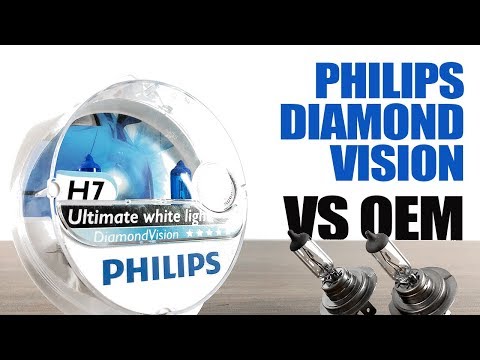
Our verdict
Philips Diamond Vision is a style-first bulb. Its 5,500K result is 2,075K cooler than OSRAM Original and delivers the blue-white appearance the product promises. The price is substantial output loss: reflector low and high beam fall about 28% and 32%, projector low and high beam fall about 37% and 38%, and total output drops roughly 51% to 769 lumens. A 2.7-year estimated life and broad sizing do not offset that visibility tradeoff for most drivers.
What we liked
- The 5,500K measurement is one of the whitest halogen results in the chart.
- The current record covers eight common bulb sizes.
- Standard 55-watt construction avoids conversion hardware.
What to consider
- Every recorded reflector and projector measurement is far below the reference.
- Measured output is only 769 lumens per bulb, about 51% below OSRAM Original.
- The current record contains no warranty term or dedicated current beam photographs.
A heavily tinted appearance bulb
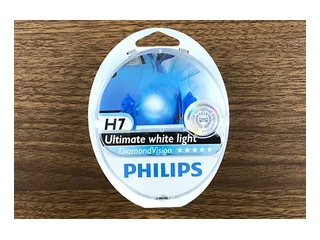
Diamond Vision is a conventional 55-watt halogen bulb. It uses no ballast, driver, fan, heat sink, or conversion harness, so installation remains similar to the original bulb when the base and application are correct.
The strongly blue-tinted glass is central to the 5,500K appearance. That coating filters the warmer portion of the light, and the current lumen and beam measurements show the cost of creating that color.
The chart records 9003, 9005, 9006, H1, H3, H4, H7, and H11 sizes. Exact-vehicle compatibility and local road-use rules still require verification.

 Historical version 1.0 videoWatch the original Diamond Vision reviewUseful background, but its older figures may differ from the current chart results on this page.
Large losses in both reflector beams
The very white appearance comes with substantially less focused output in the reflector reference housing.
About these tests: Measurements come from BulbFacts reference housings for consistent product comparison. They are not exact-vehicle results; seating, optics, lens condition, and aim can change real-world output.
Gray dots show every scored bulb. Named markers are current BulbFacts recommendations. The 5.0 reference is a baseline, not a maximum.
Reflector performance score 0.6 compared with 83 scored halogen bulbs and the 5.0 reference baseline.
- Low-beam hotspot
- 268 luxper bulb
Reflector low-beam output of 268 lux compared with 83 halogen bulbs.
- High-beam output
- 595 luxper bulb
Reflector high-beam output of 595 lux compared with 83 halogen bulbs.
- Reference low beam
- 373 lux
- Reference high beam
- 876 lux
- Reference color
- 3,425 K
- Reference output
- 1,564 lm
The 0.6 reflector score is far below OSRAM Original at 2.5. The product does achieve its color goal, but the current result does not support it as a road-light upgrade.
CrystalVision Ultra is much more usable in reflectors at 358 low lux, 940 high lux, and a 2.4 score, although its 3,675K color is warmer. Color and output are a direct tradeoff here.
The projector result is weaker still
The projector reference housing does not recover the filtered output; both beams remain far below the reference.
Gray dots show every scored projector result. Named markers are current BulbFacts recommendations. The 5.0 reference is a baseline, not a maximum.
Projector performance score 0.4 compared with 82 scored halogen bulbs and the 5.0 reference baseline.
- Low-beam hotspot
- 179 luxper bulb
Projector low-beam output of 179 lux compared with 82 halogen bulbs.
- High-beam output
- 577 luxper bulb
Projector high-beam output of 577 lux compared with 82 halogen bulbs.
The 0.4 projector score confirms that Diamond Vision is not merely sensitive to one reflector design. The same output penalty carries into the projector reference housing.
CrystalVision Ultra reaches 307 low lux, 1,017 high lux, and a 2.6 score in the same projector chart. Drivers prioritizing road light should compare stronger current bulbs instead of choosing by color alone.
Very white for halogen, with roughly half the lumens
The product reaches its visual goal, but the lumen chart shows the scale of the compromise.
Diamond Vision Kelvin
Diamond Vision lumens
We measured 5,500K, 2,075K above the OSRAM Original reference at 3,425K. That is an unusually cool result for a halogen bulb and explains why Diamond Vision can resemble HID or LED color from a distance.
Total output measured only 769 lumens per bulb, 795 lumens or roughly 51% below the 1,564-lumen reference. The color is not creating more light; the coating is trading away a large amount of output to change its appearance.
Lifespan, fit, and value
Ordinary installation and broad sizing are helpful, but output remains the deciding ownership issue.
Appearance tradeoff
- Electrical rating
- 55 W standard-wattage category
- Estimated price
- $20–34 varies by size and seller
- Cooling and noise
- N/A no LED-style cooling system
- Recorded warranty
- Not recorded confirm seller terms
The lifespan is not the main concern
The current data estimates 2.7 years for Diamond Vision versus 4 years for OSRAM Original. That is shorter than the reference, but the much larger issue is the loss of focused output and total lumens.
The estimated price is $20–34. Even at the low end of that range, value depends almost entirely on prioritizing the 5,500K appearance over road-light performance.
Recorded sizes and vehicle fit
The chart records 9003, 9005, 9006, H1, H3, H4, H7, and H11. Confirm the exact bulb code, socket, housing, vehicle guide, and road-use legality before ordering.
Should you buy it?
Philips Diamond Vision genuinely produces a white-blue 5,500K halogen color. If that appearance is the only goal, the product delivers what its name and packaging suggest.
For driving performance, the current evidence is difficult to overlook. Both reference housings lose substantial low- and high-beam intensity, total output is roughly half the stock-style reference, and estimated life is also shorter.
We do not recommend Diamond Vision as a visibility upgrade. Choose it only after accepting the measured output loss, confirming local legality and fitment, and deciding that appearance matters more than usable road light. CrystalVision Ultra or current performance-focused bulbs are more balanced alternatives.
If the 5,500K appearance is worth the measured output tradeoff for your application, check the current price or compare the complete chart before deciding.
Full measurements and specifications
Open this reference for every recorded measurement, specification, unavailable field, and test-context detail. The main reflector and projector findings remain visible above.
Show all recorded measurements and specificationsFive groups · current chart record
Measured output
- Reflector performance score
- 0.6; 5.0 reference baseline
- Reflector low-beam hotspot
- 268 lux per bulb
- Reflector low-beam change
- About 28% below OSRAM Original
- Reflector high-beam output
- 595 lux per bulb
- Reflector high-beam change
- About 32% below OSRAM Original
- Projector performance score
- 0.4; 5.0 reference baseline
- Projector low-beam hotspot
- 179 lux per bulb
- Projector high-beam output
- 577 lux per bulb
- Measured lumens
- 769 lm per bulb
Beam quality
- Reflector beam-pattern rating
- Not recorded in the current halogen data
- Reflector glare measurement
- Not recorded in the current halogen data
- Projector beam-pattern rating
- Not recorded in the current halogen data
- Projector glare measurement
- Not recorded in the current halogen data
- Historical comparison graphics
- Version 1.0; not used as current evidence
- Dedicated current beam photographs
- Not recorded for the current chart record
Color, power, and reference
- Measured color temperature
- 5,500 K
- Electrical rating
- 55 watts per bulb
- OSRAM Original reflector low beam
- 373 lux per bulb
- OSRAM Original reflector high beam
- 876 lux per bulb
- OSRAM Original projector low beam
- 284 lux per bulb
- OSRAM Original projector high beam
- 935 lux per bulb
- OSRAM Original color
- 3,425 K
- OSRAM Original output
- 1,564 lm per bulb
Dimensions, features, and recorded compatibility
- Recorded product sizes
- 9003, 9005, 9006, H1, H3, H4, H7, H11
- Product identity
- Philips Diamond Vision blue-coated halogen bulb
- Cooling method
- N/A; conventional halogen bulb
- Fan noise
- N/A; no LED-style cooling fan
- CANBUS status
- N/A in the current product data
- Exact-vehicle fitment
- Unconfirmed; verify bulb type, seating, housing, vehicle guide, regional product, and legality
- Housing context
- Reflector and projector reference housings; not an exact-vehicle test
Lifespan, price, and test status
- Estimated price
- $20–34
- Estimated lifespan
- 2.7 years
- OSRAM Original estimated lifespan
- 4 years
- Recorded warranty
- Not recorded; confirm current seller terms
- Publication date
- December 9, 2017
- Last updated
- September 15, 2026
- Test status
- Current chart record; original video and graphics used version 1.0
- Current Philips comparison
- CrystalVision Ultra is warmer but substantially stronger in both housings
Facts above follow the Diamond Vision record in the current BulbFacts halogen data. See how we test for current procedures. Product applicability still depends on exact bulb size, product identity, housing, vehicle configuration, installation, and local regulations.